Monday, July 5, 2010

Module 3 Gracias/Thanks by Pat Mora


A. BIBLIOGRAPHY
Mora, Pat. 2009. GRACIAS/THANKS. New York, NY: Lee & Low Books. ISBN 600602580. Illustrated by John Parra.

B. PLOT SUMMARY
A young multiracial boy celebrates family, friendship and fun by telling about some of the everyday things for which he is thankful.

C. CRITICAL ANALYSIS (INCLUDLING CULTURAL MARKERS)
Mora’s writing is full of descriptive words that will resonate with students and adults. Nice descriptive phrases like, “the ladybug that landed on my finger, a little red flying surprise” and “my uncle and his guitar that turns our dogs into howling singers” will entertain children of all ages. The theme of thanksgiving is a timeless theme that needs to be explored and discussed with young readers. The main character in the book is interested in classic pastimes, like baseball, the ocean and bugs. This book will be a good addition to any collection.
The bilingual format with Spanish wording on one page and the English counterpart on the opposite page is not a distraction.
The Hispanic cultural marker of family is particularly present. The boy gives thanks to his mom for finding his homework, his “abuelita” for special winks and money and his brother and sister for making him laugh. The only specific food mentioned is mashed peas so there are no specific cultural food references. Mora chooses to use the term “abuelita” the English page, as well as the Spanish as reference to the grandmother. This is the only Spanish word included on the English translation side. Special family times are highlighted throughout the book. The family goes on vacation to the beach, spends time outside and celebrates after a recital together.
Parra’s pictures accompany the text nicely. The characters have varied facial coloring. The young boy is brown and his father is a darker brown. A friend, Billy, appears to be African American. The mother is light skinned with blonde hair. There are no specific cultural references in the illustrations, other than the skin color.

D. REVIEW EXCERPTS
2010 ALA Notable Book

2010 Belpré Illustrator Honor Book

“*Starred Review* …The bilingual format features Spanish on the left-hand page and English on the right, and the dedication and author’s note are also printed in both languages. Books of thanks can run toward clichés, but the originality and liveliness of language and art in this one will inspire children to consider their own blessings.” BOOKLIST

“…Multicultural characters are revealed page by page, but unless readers are paying close attention, they might not pick up on the boy’s Mexican-American heritage. This delightful bilingual book has universal appeal and would be a wonderful choice for library storytimes or classroom read-alouds as the “giving thanks” theme lends itself to holidays and social topics. The author’s endnote challenges readers to list the things for which they are thankful. A must buy for all libraries looking to add to their children’s Spanish collections.”–SCHOOL LIBRARY JOURNAL

E. CONNECTIONS
Discuss with students the things they are thankful for and have them write them down.
Engage in a read-aloud with someone reading the Spanish text and someone else reading the English.
Visit Pat Mora and John Parra’s personal websites and learn more about the author and illustrator.

Thursday, July 1, 2010

Module 3 My Abuelita


A. BIBLIOGRAPHY
Johnston, Tony. 2009. MY ABUELITA. New York, NY: Harcourt Children’s Books. ISBN 9780152163303. Illustrated by Yuyi Morales

B. PLOT SUMMARY
A child’s grandmother is a lively, exuberant character who tells stories, eats “huevos estrellados” and works as a storyteller.

C. CRITICAL ANALYSIS (INCLUDLING CULTURAL MARKERS)
Johnston’s book is full of lively descriptive words to characterize a unique and special grandmother. She is “as old as the hills” and “round like a pumpkin” but it is clearly obvious that her grandson loves and respects her. Like most children, the grandson is confused by the ways of adults. When the grandmother yodels and stretches her body all children will find this humorous. Food is one recurring Mexican American theme seen in the book. Grandmother eats “huevos estrellados, starry eggs, queso, cheese, and tortillas.” Johnston chooses to put the English word directly next to the Spanish word and does not include a glossary in the back. The only stereotypical use of Spanish observed was, “Ay!” when the grandmother made a mistake. It felt more like a statement Bart Simpson would have made and not a grandmother. Overall, the incorporation of Spanish words is done appropriately and it does not make the wording choppy or disjointed.

Morales’ illustrations are another highlight of the book. They were created with polymer clay, wire, felting wool, acrylic paints, fabric, wood, metals and Mexican crafts and then digitally manipulated. The bright colors used are traditional of Hispanic culture. Mexican craft elements like a black and white skeleton and food images of tortilla and queso are seen in the background. An Aztec pyramis is also a prop the grandmother uses as she tells stories. The illustrator’s dedication is to “grandmothers of all shapes and colors” and his designs are respectful. Even abuela’s large size is comically exaggerated and not mean spirited. Besides the bright colors on the pages and the brown skin of the characters, the illustrations take on a fantasy perspective due to the digital manipulation and not an overly Hispanic cultural interpretation. All grandmothers and grandchildren could enjoy this book.

D. REVIEW EXCERPTS“…The book lacks a glossary and pronunciation guide, but the many Spanish terms are well defined within the boy's engaging and poetic narrative, in which he conveys his admiration and affection for his appealingly peppy grandmother. Some of the verbal imagery may be a bit esoteric for younger or more literal readers, but the eye-catching, mixed-media illustrations, sparked with bright patterns, textures, and color, will help reinforce the meaning in the words. A charming tribute to family and the joys and inspiration that storytelling can bring.” BOOKLIST

“…The story follows the boy narrator as he helps his adored grandmother, a professional storyteller, get ready for a performance at a local school. Johnston conjures up a senior citizen of enormous creativity and indomitable spirit—Abuelita exercises her voice with deep, boggy, froggy notes and wraps herself in a striped towel that makes her look and hum like a great big bee. But Morales is already conveying all that through her impishly expressive puppets (in a scene where the rotund grandmother describes herself as being round like a calabaza, her reflection in the mirror envisions her as a pumpkin), unpredictable perspectives (including a bird's-eye view of a bathroom) and a glowing palette drawn from Mexican folk art. The vignettes seamlessly knit together realism and fantasy, giving every spread a dreamy physicality.” PUBLISHERS WEEKLY

“…Characters molded from polymer clay are dressed in brightly patterned fabrics and placed among images that evoke Mexican art. Abuelita's mirror is framed by traditional metalwork, and her storytelling props include a winged serpent and a Day of the Dead skeleton. While the story is firmly placed in a Mexican context, children of all ethnic and racial backgrounds will be drawn to the eye-catching illustrations and the universal story of a loving intergenerational relationship.” SCHOOL LIBRARY JOURNAL

E. CONNECTIONS
Discuss students’ relationships with their grandparents. What kinds of foods to they fix? What types of stories do they share with their grandchildren?
What did students notice about Morales’ illustrations? Many details in the pictures need to be seen close up to catch.

Thursday, June 24, 2010

Module 2 Sing to the Sun


A. BIBLIOGRAPHY
Bryan, Ashley. 1992. SING TO THE SUN. New York, NY: Harper Collins. ISBN 060208295.
B. PLOT SUMMARY
A collection of poems and paintings celebrating the ups and downs of life. African American culture is highlighted in the original illustrations.

C. CRITICAL ANALYSIS (INCLUDLING CULTURAL MARKERS)
Bryan’s poetry is easy to read and follow for young readers. He writes in free verse style, with few words on each line. Fortunately, the brightly colored illustrations add more depth.
African American culture is a large focal point in Mr. Bryan’s work. Cultural markers include describing skin color “dark as cloves and cocoa brown” and hair “the braided beaded lady.” One entire poem, Beaded Braids, is written in admiration of braids, “Beaded lady, smiles, colors glow, through quiet grays – remarkable.”
The strength of family is seen with specific poems about Granny, Mom and Dad. Bryan’s grandmother comes alive with a vivid description of her selling fruit and putting baskets on her head. Language patterns like, “Want a lickin’? Mash me down, nuh, You t’ink me name chicken!” sound foreign and maybe from an island, like the Bahamas. Elements of nature, like rain and flowers, are also appreciated. “I’ll feed my little children, ‘cause they knows what feeds my soul.” Bryan notices the little things in the world and sees the beauty in all of it.
Bryan’s illustrations are also full of African American cultural markers. For example, his characters have strong facial features and various shades of brown skin tone. Tribal elments, like drums and headdresses are also seen in the illustrations.

D. REVIEW EXCERPTS
Lee Bennett Hopkins Poetry Award
“…Bryan does a magnificent job of conveying an evocative and palpable message to young listeners and readers. Illustrations in his distinguished style depict characteristics of African-American culture combined with flowers, birds, fish, rising suns, and full moons to create a splendid artistic work with wide appeal. SCHOOL LIBRARY JOURNAL
"The words are simple but they dance." BULLETIN OF THE CENTER FOR CHILDREN’S BOOKS

E. CONNECTIONS
Compare this book to others by Bryan like, LET IT SHINE and BEAUTIFUL BLACKBIRD.
Bryan’s somewhat autobiographical poem, The Artist, is a great poem for kids to discuss the therapeutic value of writing.

Wednesday, June 23, 2010

Module 2. Locomotion by Jacqueline Woodson


A. BIBLIOGRAPHY
Woodson, Jacqueline. 2003. LOCOMOTION. New York, NY: G. P. Putnam’s Sons. ISBN 399231153.

B. PLOT SUMMARY

African American eleven year old Lonnie writes poetry to grieve after the death of his parents and family upheaval. His school teacher encourages his writing as a therapy to deal with living in a foster family and not being near his sister.

C. CRITICAL ANALYSIS (INCLUDLING CULTURAL MARKERS)
Woodson’s writing style will have both young adults and adults enjoying this book. Lonnie is a complex character with heart and soul. Woodson’s sparse free verse style is simple and clean. The reader can envision a young boy writing this way and feeling so much emotion in all these words. Lonnie lost his parents in a house fire and lost his younger sister as a result of not having relatives able to take care of them both. It is a refreshing change to read a book about loss from a boy’s point of view. Many authors would write emotional topics like this only from a girl’s point of view. Readers will also appreciate that these poems do not rhyme and are not catchy and upbeat.

Woodson’s writing will be appreciated by the African American community because it portrays strong characters with high character and depth. Lonnie struggles with being a black young adult by saying, “Ms. Marcus don't understand some things even though she's my favorite teacher in the world. Things like my brown, brown arm.” At first, Lonnie sees many differences between him and a new student, Clyde, who is from the country. The reader does not know Clyde’s race but can sense that he is viewed as an outsider. Fortunately, Lonnie gets to know him better and they realize they both lived in Georgia and have more in common. It was a nice touch by Woodson to allow the characters to get to know each other and not continue to judge one another. Other cultural markers include an importance of church and family bonds. Lonnie goes to church with his foster mother and goes with his sister’s new family. He realizes the importance of impressing his sister’s new mother by showing piety at church. Woodson also uses African American names as characters. For example, LaTenya and Lamont. The predominantly African American genetic disease, sickle cell anemia, is also discussed when a classmate gets it. The dialect and Lonnie’s writing style are not overly African American and not stereotypical. Slang shortcuts like, ‘cause and fo’ are used sparingly. Most readers will see this as being modern and present day and not trying too hard to be from a certain culture.

D. REVIEW EXCERPTS“…Woodson, through Lonnie, creates (much as Sharon Creech did with the boy narrator in Love That Dog) a contagious appreciation for poetry while using the genre as a cathartic means for expressing the young poet's own grief.” PUBLISHERS WEEKLY

“…Despite the spare text, Lonnie's foster mother and the other minor characters are three-dimensional, making the boy's world a convincingly real one. His reflections touch on poverty and on being African American when whites seem to have the material advantages, and return repeatedly to the pain of living apart from his younger sister. Readers, though, will recognize Lonnie as a survivor. As she did in Miracle Boys (Putnam, 2000), the author places the characters in nearly unbearable circumstances, then lets incredible human resiliency shine through. "I sneak a pen from my back pocket,/bend down low like I dropped something./The chorus marches up behind the preacher/clapping and humming and getting ready to sing./I write the word HOPE on my hand." SCHOOL LIBRARY JOURNAL

E. CONNECTIONS
Discuss the poetry of Langston Hughes and Richard Wright, two poets Lonnie mentions studying in the book. Which poems of Hughes and Wright would Lonnie have enjoyed?

Discuss sickle cell anemia after reading about Lonnie’s classmate having the disease. Discuss the impact of this disease on the African American community.

Module 2. John Henry by Julius Lester, illustrated by Jerry Pinkney


A. BIBLIOGRAPHY
Lester, Julius. 1994. JOHN HENRY. New York, NY: Dial Books. ISBN 803716060.

B. PLOT SUMMARY
The story of John Henry, a legendary folk hero, is retold by Mr. Lester. John Henry is a larger-than-life man who uses a sledge hammer to drill through a mountain to lay railroad tracks.

C. CRITICAL ANALYSIS (INCLUDLING CULTURAL MARKERS)
Lester’s version of the famous African American folktale is well crafted. John Henry’s story is full of folktale fantasy, like animals that visit and care for humans and a sun and moon that cheer and cry. The use of descriptive writing is nicely done. Students will enjoy imagery like, “the boulder shivered like you do on a cold winter morning” and “the air seemed to be dancing to the rhythm of his hammers.”
Lester also uses an appropriate amount of country dialect so readers realize the setting. “I need light to do ‘em by” and “it scurried from behind the moon’s skirts” are two examples of regional dialect. The dialect is done in a positive and upbeat manner and not demeaning to the culture in any way. John Henry’s physical attributes are described as being strong and growing and being able to physically compete against modern machines. Besides John Henry’s physical attributes, his hard work and ability to get along with others are highlighted in the book. He makes compromises with others to end arguments and keep the peace. John Henry’s ability to care for others is seen as his biggest asset in the story.
Pinkney’s illustrations are helpful to the reader to visualize the action. The pictures of John Henry as a young baby, he looks like a bright eyed young African American child with tight ringlet hair and bright eyes. His parents are also pictured as two different shades of black, which is a nice feature of the artist to include. There are too many stories where all the characters the same shade of color. As John Henry grows, Pinkney’s illustrations continue to evolve too. John Henry’s facial features look like many African American men with a strong, distinctive nose and full set of lips. This is done in an appropriate manner and not in a satirical fashion. Pinkney uses muted colors and a lot of color blending. His pictures are best viewed by the reader in a close setting instead of a large read aloud.

D. REVIEW EXCERPTS“…This carefully crafted updating begs to be read aloud for its rich, rhythmic storytelling flow, and the suitably oversize illustrations amplify the text. As only one example, the animal witnesses of his birth reappear throughout, most notably to watch John Henry's funeral train pass by. This may not supplant more traditional retellings, such as Terry Small's The Legend of John Henry, but it is a triumph of collaboration from the creators of the noted Uncle Remus retellings.” PUBLISHERS WEEKLY

“…Lester's tale is true to the essence of the steel-driving man; yet, it allows room for touches of whimsy and even includes some contemporary references that tie the hero to our own times. Told with just a trace of dialect, the story moves along briskly toward the climax. Its moral message of the importance of a well-lived life is clearly stated, and the ending is uplifting.” SCHOOL LIBRARY JOURNAL

E. CONNECTIONS
Use map skills to identify the Allegheny Mountains in West Virginia, the setting of the fictional race between John Henry and the steam drill.
Listen to one of the musical ballads of John Henry and compare it to the book’s version.
Read stories about Paul Bunyan and Baby the Ox and note similarities and differences.
Read other stories written by Julius Lester and illustrated by Jerry Pinkney, like The Tales of Uncle Remus: The Adventures of Brer Rabbit and Sam and the Tigers.

Sunday, June 13, 2010

Module 1 The Cat or How I Lost Eternity


A. BIBLIOGRAPHY
Richter, Jutta. 2007. THE CAT OR HOW I LOST ETERNITY. Minneapolis, MN: Milkweed Editions. ISBN 1571316760. Translated by Anna Brailovsky.
Originally published: Munich: Carl Hanser Verlag, 2006 under the title, Die Katze.

B. PLOT SUMMARY
Young girl Christine is an imaginative girl who likes to spend the day talking to an alley cat. The cat gets her into trouble by making her late to school and tries to teach her to be spiteful and pitiless.

C. CRITICAL ANALYSIS (INCLUDLING CULTURAL MARKERS)
This is a complex read that few children will fully grasp or enjoy. The title and summary are misleading because it is not a playful book about a girl with an active imagination and an imaginary cat. The main character, Christine, is a lonely child who has found it easier to communicate with an imaginary cat instead of interact with the real world. Christine is a balanced character because she struggles with many decisions all humans make. For example, Christine is not sure whether to befriend a dog or a new neighbor. By listening to the cat, she chooses to ignore both. The cat takes on the role of playing the universal theme of good vs. evil. Luckily, Christine does mature by the end and is more comfortable making her own decisions independently. The theme of coming of age is a theme that all cultures can appreciate and relate.

This selection is void of any cultural detail and most readers would not know it was originally published in Germany unless they read the bibliography. The story could have taken place in any street in any city in the world. It has so few details that it makes it a very cold and sparse read. The setting is also unclear on whether it is a historic or contemporary time. The illustrations are modern and cold. They do not add to the story or help the reader visualize the character development.

I would recommend libraries pass on purchasing this book for their children or young adult collection.

D. REVIEW EXCERPTS
Eight-year-old Christine is late for school every day because she is stopped by a white alley cat that insists on talking to her. They discuss math and loneliness and eternity. While at first Christine feels an affinity with the cat, it later repulses her. The conversations eventually come to an end once Christine stops believing that the feline has anything wise or useful to say to her. It acts the role of The Serpent, trying to lure the Eve-like Christine into doing and being what she knows is not right. There is even a discussion about the Tree of Knowledge and Original Sin at the end to hammer home the point. There is an abundance of unpleasant food imagery (starting with the fish smell that the cat leaves on Christine's hand whenever she touches it), male characters who are either incompetent or unfeeling, and an eclipse that represents the end of the world. It is hard to imagine a broad audience for this book. SCHOOL LIBRARY JOURNAL

E. CONNECTIONS
Discuss the values and character themes (willfulness, friendship, and compassion) witnessed in the book.
Discuss the theme of coming of age and losing one’s imagination and imaginary friends.

Thursday, June 10, 2010

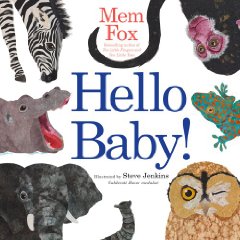
Module 1 Hello Baby!


A. BIBLIOGRAPHY
Fox, Mem. 2009. HELLO BABY! New York, NY: Simon & Schuster. ISBN 416985136.

B. PLOT SUMMARY
A baby encounters a variety of young animals, including a monkey, elephant, owl and hippopotamus in search for learning more about themselves and the lively animals.

C. CRITICAL ANALYSIS (INCLUDLING CULTURAL MARKERS)
Fox’s rhyming text will be a hit with the intended toddler audience. Animals are always a popular subject and Fox creates vivid images with her use of strong of action phrases, like “twitching its nose and wielding a tusk.” Adults will also appreciate this use of advanced vocabulary because it is a nice break from picture books that only use easy reader vocabulary. This book will appeal to children across the world because of its universal topic and “feel-good” nature. Readers will delight in the ending when they realize that they are their parents’ special gift. There are no easily identifying markers that would lead a US reader to think the author was foreign. This book’s appealing format will work with all young readers and will endure the test of time.

Jenkins’ paper illustrations also enhance this book. The illustrations are large and typically cover over one page. Young children will be able to notice tiny details like the elephant’s eyelashes or the crocodile’s sharp teeth.

D. REVIEW EXCERPTS
Starred Review. While Fox is cooing as only she can, Jenkins works his usual magic with cut paper. In many of his large-scale closeups—the images spill across and off the spreads—his subjects' big, expressive eyes seem locked in a gaze with the reader. Ingeniously stylized shapes (like the coils of gray paper that form an elephant's trunk) combine with sumptuous detailing that brings alive the parade of scales, fur and feathers. PUBLISHERS WEEKLY

Fox's rhyming text is pure fun. In a layout reminiscent of Bill Martin, Jr.'s Brown Bear, Brown Bear, What Do You See? (Holt, 1983), an unseen narrator says, "Hello, baby!/Who are you?" and the speculated answers range from the familiar elephant to an exotic gecko. "Are you a zebra/sipping a drink?/Perhaps you're an owl/with a wicked wink." A spread near the end of the book provides an opportunity to name the baby animals by looking at their silhouettes. Jenkins's beautifully shaded and textured collages are stand-alone works of art, each of which holds its own with Fox's engaging cadences. This collaboration results in a lovely read-aloud for preschool storytimes or a perfect selection for one-on-one sharing. SCHOOL LIBRARY JOURNAL

E. CONNECTIONS
Create your own unique paper illustrations like the ones that are in the book.
Read other stories by Mem Fox, like WHERE IS THE GREEN SHEEP? and compare the similarities and differences.
Examine other books illustrated by Steve Jenkins, like WHAT DO YOU DO WITH A TAIL LIKE THIS? and compare.
Try writing in Fox’s style by using action verbs with animals.