Showing posts with label Asian American literature. Show all posts

Monday, July 19, 2010

Module 5 Tea With Milk


A. BIBLIOGRAPHY
Say, Allen. 2006. TEA WITH MILK. New York, NY: Sandpiper. ISBN 0547237472.

B. PLOT SUMMARY
After growing up near San Francisco, a young Japanese woman returns with her parents to Japan but she feels foreign and out of place.

C. CRITICAL ANALYSIS (INCLUDLING CULTURAL MARKERS)

Say’s story is deeply personal because it is about his mother and father. His mother, Masako or May, is the central character who feels out of place when she moves back to Japan. Many immigrant people will relate to the feelings of May. Say adds Japanese details nicely. May is not accepted by her Japanese classmates and is called “gaijin” which means foreigner. She does not understand Japanese culture and traditions like the kimono or tea ceremony. She enjoys wearing American dresses and hats instead of the kimono. Being a “good Japanese wife” is very important to May’s parents and May revolts. The theme of acceptance is seen as May moves to the city of Osaka and gets a job.
Say’s illustrations add to the story by showing how May stands apart. When she dresses in bright red and the rest of the picture is muted, it clearly shows how different she is. Say attempts to differentiate the characters by their hairstyles and facial expressions. Primarily, May stands apart by her different attire.

D. REVIEW EXCERPTS
ALA Notable Book
SLJ Best Book
“Continuing the story he started in Grandfather's Journey (Houghton, 1993), Say explores familiar themes of cultural connection and disconnection. The pages are filled with detailed drawings featuring Japanese architecture and clothing, and because of the artist's mastery at drawing figures, the people come to life as authentic and sympathetic characters. This is a thoughtful and poignant book that will appeal to a wide range of readers, particularly our nation's many immigrants who grapple with some of the same challenges as May and Joseph, including feeling at home in a place that is not their own.” SCHOOL LIBRARY JOURNAL

“Say's masterfully executed watercolors tell as much of this story about a young woman's challenging transition from America to Japan as his eloquent, economical prose. His exquisite, spare portraits convey emotions that lie close to the surface and flow easily from page to reader: with views of Masako's slumping posture and mask-like face as she dons her first kimono, or alone in the schoolyard, it's easy to sense her dejection. Through choice words and scrupulously choreographed paintings, Say's story communicates both the heart's yearning for individuality and freedom and how love and friendship can bridge cultural chasms.” PUBLISHER’S WEEKLY

E. CONNECTIONS
Read Say’s GRANDFATHER’S JOURNEY and see how these characters began.
Study author Allen Say’s biography and learn more about his background.

Module 5 The Name Jar


A. BIBLIOGRAPHY
Choi, Yangsook. 2001. THE NAME JAR. New York, NY: Alfred Knopf. ISBN 375906134.

B. PLOT SUMMARY
After Unhei moves from Korea to the United States, her new classmates help her decide what her name should be.

C. CRITICAL ANALYSIS (INCLUDLING CULTURAL MARKERS)

Choi writes a book that most adolescent children will relate to because of the childhood themes of fitting in and acceptance by peers. When Unhei moves to the United States she wants to be a regular American child, like the ones she sees on her school bus. She feels like her Korean name is holding her back from fitting in. The setting is present day and depicted accurately by modern buildings and neighborhoods. Unhei experiences name calling like, “Oh, it’s Yoo-hey, like You, hey!” The ending of the story is poignant because the central character decides to accept her name and embrace the Korean culture within her.
Many Korean elements are seen throughout the book. The Korean name symbol is used extensively and is seen as a cherished possession to Unhei. The family cooks kimchi and shops at a Korean grocery. The mom says, “Just because we’ve moved to America doesn’t mean we stop eating Korean food.” The parents reinforce some of the stereotypical Asian stereotypes by stressing academics. “You must study hard, behave nicely, and get good grades to show that you’re a good Korean.”
The illustrations are in yellow and gold tones and depict a Korean American family. There is a Korean calendar on the wall and scenes with chopsticks. The American classmates are diverse looking with a variety of skin tones and hair color. All the Koreans look the same. Their eyes are the same size and eyebrows are identical.

D. REVIEW EXCERPTS
“…The bold, bright paintings that illustrate the story are realistic, warm, and appealing. Unfortunately, the text sags under the weight of its mission to describe how it might feel to immigrate. A well-meaning and visually attractive effort, but uninspired.” SCHOOL LIBRARY JOURNAL

“….The paintings are mostly in gold and earth tones, and the figures have both stature and simplicity--as does the story.” BOOKLIST

E. CONNECTIONS
Discuss different names among students. Many students have names that have traditional meaning.
Discuss if any students shop at specific markets when Unhei shops at the Korean grocery store. Ask them what ingredients they shop for. 

Module 5 Year of the Dog


A. BIBLIOGRAPHY
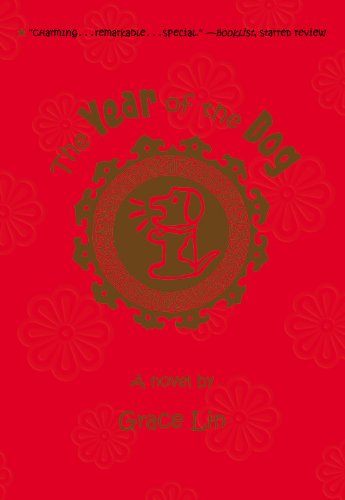
Lin, Grace. 2006. THE YEAR OF THE DOG. New York, NY: Little, Brown and Company. ISBN 316060003.

B. PLOT SUMMARY
A young Taiwanese American girl, Grace, sets out to apply the lessons of the Chinese Year of the Dog, make friends and achieve goals set for herself.

C. CRITICAL ANALYSIS (INCLUDLING CULTURAL MARKERS)

Grace is a sweet character that will be enjoyed by most young girl readers. She has many of the same struggles that most adolescents have with friends, boys and family members. In addition to the regular modern day struggles, Grace uses this year to figure out more about being Taiwanese American. This book is a good example of separating out the many different Asian cultures. Lin writes about the unique characteristics of being from Taiwan and getting lumped together with all other Asian cultures. “But I’m not really Chinese either. It’s kind of confusing. My parents came from Taiwan. Some people thought Taiwan was part of China.” Luckily Grace doesn’t get bogged down in the details, she is confident that she’s the right amount Taiwanese and the right amount American. One literary element that was overused was the retelling by Grace’s mom. Every retelling session began, “Did I ever tell you about the time I…” This was too formulaic and could have been handled better.
Many cultural elements are included in the book. The book starts with the New Year celebration. Chinese is spoken to relatives to share New Year greetings, “Gong xi-gong xi!” Lin also incorporates appropriate use of special foods for these celebrations. One unique part was where Grace visits a friend’s house and doesn’t recognize the Chinese food. “Are you sure this is Chinese food?” she asks. This is a very realistic depiction because every family has a different take on special food dishes. Grace also struggles to “American enough” to have a role in the school play, Wizard of Oz, because she knows there were no Asian munchkins. Grace also criticizes the famous Chinese book, The Seven Chinese Brothers, by stating, “Those aren’t real Chinese people, your brother doesn’t have a ponytail.” This realization leads Grace to write her own book with “people like us-Chinese Americans.” Other struggles as a Chinese American are relatable to many multicultural students when Grace wants a turkey for Thanksgiving but her parents prefer fried dumplings.
The illustrations are simple pen and ink sketches that are similar to what a preteen would have in a journal. Many of the drawings are helpful to the reader because they identify different foods, like the New Year’s Tray, rice porridge and Chinese symbols. Due to the simple nature of the illustrations, all facial features are similar and very linear.

D. REVIEW EXCERPTS
APAAL Honorable Mention in Text for Children and Young Adult Literature Award

“A lighthearted coming-of-age novel with a cultural twist. Readers follow Grace, an American girl of Taiwanese heritage, through the course of one year–The Year of the Dog–as she struggles to integrate her two cultures. Throughout the story, her parents share their own experiences that parallel events in her life. These stories serve a dual purpose; they draw attention to Graces cultural background and allow her to make informed decisions. She and her two sisters are the only Taiwanese-American children at school until Melody arrives. Small, captioned, childlike black-and-white drawings are dotted throughout. This is an enjoyable chapter book with easily identifiable characters.” SCHOOL LIBRARY JOURNAL

“*Starred Review*…Most of the chapters are bolstered by anecdotes from Grace's parents, which connect Grace (and the reader) to her Taiwanese heritage. Lin does a remarkable job capturing the soul and the spirit of books like those of Hayward or Maud Hart Lovelace, reimagining them through the lens of her own story, and transforming their special qualities into something new for today's young readers.” BOOKLIST

E. CONNECTIONS
Discuss different family traditions among students. Many students probably incorporate family cultures into the “traditional American” holidays.
Learn more about Taiwan and its history.