Monday, July 19, 2010

Module 5 The Name Jar


A. BIBLIOGRAPHY
Choi, Yangsook. 2001. THE NAME JAR. New York, NY: Alfred Knopf. ISBN 375906134.

B. PLOT SUMMARY
After Unhei moves from Korea to the United States, her new classmates help her decide what her name should be.

C. CRITICAL ANALYSIS (INCLUDLING CULTURAL MARKERS)

Choi writes a book that most adolescent children will relate to because of the childhood themes of fitting in and acceptance by peers. When Unhei moves to the United States she wants to be a regular American child, like the ones she sees on her school bus. She feels like her Korean name is holding her back from fitting in. The setting is present day and depicted accurately by modern buildings and neighborhoods. Unhei experiences name calling like, “Oh, it’s Yoo-hey, like You, hey!” The ending of the story is poignant because the central character decides to accept her name and embrace the Korean culture within her.
Many Korean elements are seen throughout the book. The Korean name symbol is used extensively and is seen as a cherished possession to Unhei. The family cooks kimchi and shops at a Korean grocery. The mom says, “Just because we’ve moved to America doesn’t mean we stop eating Korean food.” The parents reinforce some of the stereotypical Asian stereotypes by stressing academics. “You must study hard, behave nicely, and get good grades to show that you’re a good Korean.”
The illustrations are in yellow and gold tones and depict a Korean American family. There is a Korean calendar on the wall and scenes with chopsticks. The American classmates are diverse looking with a variety of skin tones and hair color. All the Koreans look the same. Their eyes are the same size and eyebrows are identical.

D. REVIEW EXCERPTS
“…The bold, bright paintings that illustrate the story are realistic, warm, and appealing. Unfortunately, the text sags under the weight of its mission to describe how it might feel to immigrate. A well-meaning and visually attractive effort, but uninspired.” SCHOOL LIBRARY JOURNAL

“….The paintings are mostly in gold and earth tones, and the figures have both stature and simplicity--as does the story.” BOOKLIST

E. CONNECTIONS
Discuss different names among students. Many students have names that have traditional meaning.
Discuss if any students shop at specific markets when Unhei shops at the Korean grocery store. Ask them what ingredients they shop for. 

Module 5 Year of the Dog


A. BIBLIOGRAPHY
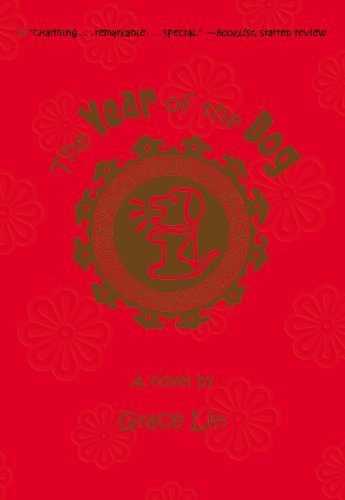
Lin, Grace. 2006. THE YEAR OF THE DOG. New York, NY: Little, Brown and Company. ISBN 316060003.

B. PLOT SUMMARY
A young Taiwanese American girl, Grace, sets out to apply the lessons of the Chinese Year of the Dog, make friends and achieve goals set for herself.

C. CRITICAL ANALYSIS (INCLUDLING CULTURAL MARKERS)

Grace is a sweet character that will be enjoyed by most young girl readers. She has many of the same struggles that most adolescents have with friends, boys and family members. In addition to the regular modern day struggles, Grace uses this year to figure out more about being Taiwanese American. This book is a good example of separating out the many different Asian cultures. Lin writes about the unique characteristics of being from Taiwan and getting lumped together with all other Asian cultures. “But I’m not really Chinese either. It’s kind of confusing. My parents came from Taiwan. Some people thought Taiwan was part of China.” Luckily Grace doesn’t get bogged down in the details, she is confident that she’s the right amount Taiwanese and the right amount American. One literary element that was overused was the retelling by Grace’s mom. Every retelling session began, “Did I ever tell you about the time I…” This was too formulaic and could have been handled better.
Many cultural elements are included in the book. The book starts with the New Year celebration. Chinese is spoken to relatives to share New Year greetings, “Gong xi-gong xi!” Lin also incorporates appropriate use of special foods for these celebrations. One unique part was where Grace visits a friend’s house and doesn’t recognize the Chinese food. “Are you sure this is Chinese food?” she asks. This is a very realistic depiction because every family has a different take on special food dishes. Grace also struggles to “American enough” to have a role in the school play, Wizard of Oz, because she knows there were no Asian munchkins. Grace also criticizes the famous Chinese book, The Seven Chinese Brothers, by stating, “Those aren’t real Chinese people, your brother doesn’t have a ponytail.” This realization leads Grace to write her own book with “people like us-Chinese Americans.” Other struggles as a Chinese American are relatable to many multicultural students when Grace wants a turkey for Thanksgiving but her parents prefer fried dumplings.
The illustrations are simple pen and ink sketches that are similar to what a preteen would have in a journal. Many of the drawings are helpful to the reader because they identify different foods, like the New Year’s Tray, rice porridge and Chinese symbols. Due to the simple nature of the illustrations, all facial features are similar and very linear.

D. REVIEW EXCERPTS
APAAL Honorable Mention in Text for Children and Young Adult Literature Award

“A lighthearted coming-of-age novel with a cultural twist. Readers follow Grace, an American girl of Taiwanese heritage, through the course of one year–The Year of the Dog–as she struggles to integrate her two cultures. Throughout the story, her parents share their own experiences that parallel events in her life. These stories serve a dual purpose; they draw attention to Graces cultural background and allow her to make informed decisions. She and her two sisters are the only Taiwanese-American children at school until Melody arrives. Small, captioned, childlike black-and-white drawings are dotted throughout. This is an enjoyable chapter book with easily identifiable characters.” SCHOOL LIBRARY JOURNAL

“*Starred Review*…Most of the chapters are bolstered by anecdotes from Grace's parents, which connect Grace (and the reader) to her Taiwanese heritage. Lin does a remarkable job capturing the soul and the spirit of books like those of Hayward or Maud Hart Lovelace, reimagining them through the lens of her own story, and transforming their special qualities into something new for today's young readers.” BOOKLIST

E. CONNECTIONS
Discuss different family traditions among students. Many students probably incorporate family cultures into the “traditional American” holidays.
Learn more about Taiwan and its history.

Tuesday, July 13, 2010

Module 4 Jingle Dancer


A. BIBLIOGRAPHY
Smith, Cynthia L. 2000. JINGLE DANCER. New York, NY: Morrow Junior Books. Illustrated by Cornelius Van Wright and Ying-Hwa Hu. ISBN 688162428.

B. PLOT SUMMARY
A young Muscogee Ojibway Indian, Jenna, borrows metal jingles from the dresses of several women in the community so she can perform the traditional jingle dance at the powwow.

C. CRITICAL ANALYSIS (INCLUDLING CULTURAL MARKERS)
Smith captures Jenna’s struggle to get enough jingles in a very honest and sincere fashion. Most students will relate to the themes of wanting something and being accepted as a young adult. Onomatopoeia like, tink tink and brum brum is used to enhance the sounds of the dancing. The book is a nice addition to any collection because it is the story of a modern day Native American child and family. Her relatives are professionals, like lawyers, in addition to dancers at a powwow. Jenna’s family lives in a suburban house that most students will be able to relate to.

Many Native American elements are seen throughout the story. Smith mentions many important Creek and Chippewa elements, like frybread, powwows, Indian taco and dancing regalia. Smith also uses phrases that incorporate nature into the story. For example, “As Sun fetched morning and as Sun arrived at midcircle” are used to help tell time. The importance of the celebratory powwow was also central to the story. Jenna was dancing to represent her family and her family members stressed this importance by saying, “Will you dance for me?” The number four is emphasized in the story. Jenna asks four women for help to create her dress.

The afterword by the author and the glossary are important for readers. She explains the significance for jingle dancing and the origin of jingle dresses. These explanations help the reader understand Ojibway culture better.

The illustrations are soft and muted with watercolorings. Native American elements are very abundant throughout the book. Jenna and her grandmother are dark skinned and their hair is very dark. When Jenna dances her dress and regalia are depicted accurately, according to the author’s note. Her hair is in one long braid and carries a feather and beaded belt.

D. REVIEW EXCERPTS“…Watercolor paintings in bright, warm tones fill each page. In scenes where she is dancing, backgrounds of blurred figures effectively represent both the large audience and the many generations whose tradition the gathering honors. Seeing Jenna as both a modern girl in the suburban homes of her intertribal community and as one of many traditionally costumed participants at the powwow will give some readers a new view of a contemporary Native American way of life. An author's note and glossary tell more about the Muscogee (Creek) Nation, the Ojibway origins of jingle dancing, and the significance of the number four in Native American tradition. This picture book will not only satisfy a need for materials on Native American customs, but will also be a welcome addition to stories about traditions passed down by the women of a culture.” SCHOOL LIBRARY JOURNAL

“Smith, a mixed-blood member of the Muscogee (Creek) Nation, convincingly juxtaposes cherished Native American tradition and contemporary lifestyle in this smooth debut. Van Wright and Hu's (Jewels) lifelike renderings capture the genuine affection between Jenna and these caring older women. Their easy integration of Native and standard furnishings and clothing gracefully complement Smith's heartening portrait of a harmonious meshing of old and new.” PUBLISHERS WEEKLY

E. CONNECTIONS
Use media to view clips of jingle dancing.
Try to invoke legend into group writing assignment by telling time or phrases in the manner that Smith used.
Discuss the author's personal history and see the influences in the writing.

Sunday, July 11, 2010

Module 4 Alice Yazzie's Year


A. BIBLIOGRAPHY
Maher, Ramona. 2003. ALICA YAZZIE’S YEAR. Berkeley, California: Tricycle Press. Illustrated by Shonto Begay. ISBN 582460809.

B. PLOT SUMMARY
An eleven year old Navajo girl narrates each month of a year in her life growing up in modern-day American on a reservation.

C. CRITICAL ANALYSIS (INCLUDLING CULTURAL MARKERS)
Maher captures the year of Alice, a Navajo eleven year old, in a slow moving format. The pace moves so slowly that most young readers will probably put this book down after reading a few pages. Instruction by teachers will be needed for students to gain a deeper understanding of the material. Many Native American elements are seen in Maher’s writing. She mentions many important Navajo elements, like sheepskin, pinyon wood and frybread. Alice also attends school off the reservation and goes on field trips to experience more culture, particularly white culture like Disneyland. Even though she enjoyed the trip, she was quick to point out that “nobody listened and the nicest thing was coming back here.”
Alice is proud of her Native American culture and wears squash blossom and turquoise jewelry. The coyote is also seen as a very important animal to Alice and her friends. When she adopts a coyote pup she writes, “It is her friend and is named for a friend.” The grandfather character incorporates traditional Native American role by riding a horse and wearing a headband but he also values education and wants the Navajo children to learn technology. The grandfather’s choices could be discussed by readers as whether he is evolving like other Native Americans have had to or feeling pressured to change by the white man.
Maher captures some of the Native American discontent with white people by her text. Some examples are, “Strip mined for power-the kind of power that white people know” and Alice is bothered by the white preacher’s wife pressuring her to attend Sunday school. The story of Thanksgiving and how it can mean something else to Native Americans is highlighted in the month of November. Alice tells her teacher, “We’d be glad to see Columbus sail away.”
Alice also embraces living in a modern world, as much as having traditional Navajo elements to her life. She dresses up as Australian 1980s tennis star, Evonne Goolagong, for Halloween and gives her grandfather Mickey Mouse ears. Fortunately, her grandfather seems to enjoy how Alice incorporates all cultures into their life by statements like, “Evonne Goolagong. I like that name.”
The afterword by Navajo educator Carl Gorman is important for readers. He explains the Navajo translations that are next to each month of the year. It is not a literal translation of the month like most readers probably assumed but more a little phrase about that time of the year. These explanations help the reader understand Navajo culture better.
Begay’s illustrations are vivid and bright. Native American elements are very abundant throughout the book. Alice and her grandfather are dark skinned and their hair is very dark, almost blue-black. Alice also wears her hair in traditional braids and her grandfather has a long ponytail. They both wear traditional Native American jewelry with silver and turquoise. Southwest American animals like buffalo, horses and coyote are also depicted.

D. REVIEW EXCERPTS“… Clearly meant for older readers despite the picture-book format, the book compares a buffalo's eyes to "a drunk bronc rider's," which may make the intended audience even less certain. Begay's illustrations are wonderfully textured and infused with the colors of the Southwest. For some children, the artwork may be more revealing of traditional Navajo lifestyles than the pared down, almost stream-of-consciousness text. Purchase where supplemental materials on Native American culture are needed.” SCHOOL LIBRARY JOURNAL

“…At times, Alice's perspective is political (she speaks out against Columbus in school); at other times it is lyrical (lightning is "ghosts chasing their tails"). Begay's paintings, impressionistic dabs and swirls of brilliant color, sometimes muddy faces and expressions, but like the words, the wild patterns and hues leave room for imaginations to fill in the spaces. Whether read alone or aloud, the poems tell an affecting story about contemporary Navajo life through an appealing young character with a strong sense of history and herself. Teachers will want to use this across the curriculum; a concluding section offers more background to Navajo language and culture.” BOOKLIST

E. CONNECTIONS
Visit Shonto Begay’s website, www.shontobegay.com and learn more about the artist’s background. Discuss how his life as a Native American shaped his art.
Pick out Native American terms and create a glossary for the book.

Friday, July 9, 2010

Module 4 Raccoon's Last Race


A. BIBLIOGRAPHY
Bruchac, Joseph and James Bruchac. 2004. RACCOON’S LAST RACE. New York, NY: Dial Books. ISBN 803729774.

B. PLOT SUMMARY
The retelling of an Abenaki legend of how Raccoon, the fastest animal on earth, loses his speed because he is boastful and breaks his promises.

C. CRITICAL ANALYSIS (INCLUDLING CULTURAL MARKERS)
Father and son team Joseph and James Bruchac team up once again to narrate the famous Raccoon tale. Raccoon’s Last Race is a good addition to a folklore collection and can be used to entertain children, as well as teach a lesson. The authors use repetition nicely when telling how Raccoon brags, “He would race Bear. Zip-zip! He would beat Bear. He would race Fox. Zip-zip! He would beat Fox.” Onomatopoeias like, “thump-thump, ka-boom, and splat!” are also used to add details to the action. This book is an excellent read-aloud story that has a meaningful message about discipline and the consequences of boastfulness and the failure to keep promises.

The Authors’ notes page is helpful to the reader because it provides background on the importance of the Raccoon to the Abenaki people. The Bruchacs also inform the reader that the word “Azebansoo” in Abenaki means “to act like a Raccoon or to play a trick.” The Native American motif of four is seen in this story when Raccoon races four other characters, the Bear, Fox, Rabbit and Big Rock. The illustrations provide detail about the characters and story plot but do not just an overtly obvious Indian American characteristics. The authors did not use any Abenaki language in the body of the story either. Other than the notes page, readers of this story would probably not realize they were reading a traditional Abenaki tale.

D. REVIEW EXCERPTS
“A solid retelling of an Abenaki legend. The text reads aloud smoothly and keeps the action moving quickly. Done in pen-and-ink, gouache, and pastel, the illustrations accentuate the humor of the tale. The boldly colored animals are set against softer backgrounds, and occasional close-ups add variety to the scenes. An authors' note provides some background for the story. A strong addition to picture-book collections.” SCHOOL LIBRARY JOURNAL

E. CONNECTIONS
Discuss with older readers whether or not the Bruchacs should have incorporated more Abenaki language into this story.
Compare this story to other folktales where bragging and boasting are themes, like How the Possum Lost His Beautiful Tail" as retold by Kathi Smith Littlejohn.

Tuesday, July 6, 2010

Module 3 Chato's Kitchen by Gary Soto


A. BIBLIOGRAPHY
Soto, Gary. 1995. CHATO’S KITCHEN. New York, NY: Putnam & Grosset Group. ISBN 698116003. Illustrated by Susan Guevara.

B. PLOT SUMMARY
When Chato, the hippest cat in East L.A., invites a family of mice to dinner, he and his friend Novio Boy expect a wonderful meal of chiles rellenos, enchiladas and chorizo con mice. But when the mice arrive, they bring a surprise that changes the course of the whole meal.

C. CRITICAL ANALYSIS (INCLUDLING CULTURAL MARKERS)
This humorous tale of "cat and mouse," eventually brings the diverse barrio together for an outstanding dinnner party. Gary Soto and illustrator Susan Guevara are so clever in setting the stage for a sure disaster, but readers will be surprised to learn that all ends well. Students can learn the art of suspense from reading this story. Chato, the cat, is almost licking his lips with the mice as he prepares for their dinner. Once the guests arrive, every reader will be on the edge of their seats wanting to know what happens next.
The descriptive words add to the swagger of Chato. He is described as a “low-riding cat” that mambos his hips. Chato’s friend, Novio Boy, is also described in a larger-than-life way, with “soft green eyes, sleek fur, and the loveliest growl in the barrio. Novio Boy also wore the flashiest cat collar – a leather one with real gems that sparkled at night when cars passed in the street.” Soto also includes some cat puns, like “purrrfect.”
Many Hispanic cultural markers are included in this book. The book includes a glossary of Spanish words at the beginning and a description of the foods Chato prepares. Soto and Guevara’s dedication page is also Spanish. Chato uses a sprinkling of Spanish words and phrases, like “No problema” and “Chato welcomes you to the barrio.” Even though there is a glossary at the beginning of the book, sometimes the English translation is also right next to the Spanish in the text. For example, “That Chato cat seems muy simpatico, very nice, I’m sure.” This is a little frustrating to readers who have already looked in the glossary and then see the translation on the page. This also very inconsistent because the English is not always next to the Spanish.
Food is very abundant throughout the book. Chato cooks with arroz, tortillas and flan. Many of the ingredients are also seen in Guevara’s pictures, like avocados, tomatoes and corn.
Guevara’s illustrations also depict a Hispanic American lifestyle. Chato wears his baseball hat backwards and wears low-riding shorts. His house has burglar bars, hanging bougainvillea plants and a clothesline. The kitchen ingredients are labeled “arroz” and the calendar says “Mayo”. Novio Boy also looks like a stereotypical Hispanic gangster with his bandanna slung low on his head, cross necklace and plaid shirt.

D. REVIEW EXCERPTS
1996 Pura Belpre Award

1996 ALA Notable Children's Book

“These animal characters are very human: the mouse teenager talks on her mobile phone; Chato's friend mambos to his boom box. Best of all is the fun with scale, especially in a story where the small creatures win.” BOOKLIST

“A really cool book ... Soto adeptly captures the flavor of life in el barrio in this amusing tale. Guevara's striking illustrations enrich the text with delightful, witty details.” (Starred Review) SCHOOL LIBRARY JOURNAL

“…Guevara's cats are delicious send-ups of barrio characters, and Soto's words glisten with wit: "We brought Chorizo,' Mami mouse called./ Sausage! Chato and Novio Boy danced, and with clean paws they gave each other a 'low-four.'" Salud to this magical pairing of talents.” PUBLISHERS WEEKLY


E. CONNECTIONS
Discuss with older students the illustrations and depiction of Novio Boy.
Identify the Spanish words in the story and use the glossary to figure out their meaning.
Write a different ending the story and tell the story using the new ending.

Monday, July 5, 2010

Module 3 Gracias/Thanks by Pat Mora


A. BIBLIOGRAPHY
Mora, Pat. 2009. GRACIAS/THANKS. New York, NY: Lee & Low Books. ISBN 600602580. Illustrated by John Parra.

B. PLOT SUMMARY
A young multiracial boy celebrates family, friendship and fun by telling about some of the everyday things for which he is thankful.

C. CRITICAL ANALYSIS (INCLUDLING CULTURAL MARKERS)
Mora’s writing is full of descriptive words that will resonate with students and adults. Nice descriptive phrases like, “the ladybug that landed on my finger, a little red flying surprise” and “my uncle and his guitar that turns our dogs into howling singers” will entertain children of all ages. The theme of thanksgiving is a timeless theme that needs to be explored and discussed with young readers. The main character in the book is interested in classic pastimes, like baseball, the ocean and bugs. This book will be a good addition to any collection.
The bilingual format with Spanish wording on one page and the English counterpart on the opposite page is not a distraction.
The Hispanic cultural marker of family is particularly present. The boy gives thanks to his mom for finding his homework, his “abuelita” for special winks and money and his brother and sister for making him laugh. The only specific food mentioned is mashed peas so there are no specific cultural food references. Mora chooses to use the term “abuelita” the English page, as well as the Spanish as reference to the grandmother. This is the only Spanish word included on the English translation side. Special family times are highlighted throughout the book. The family goes on vacation to the beach, spends time outside and celebrates after a recital together.
Parra’s pictures accompany the text nicely. The characters have varied facial coloring. The young boy is brown and his father is a darker brown. A friend, Billy, appears to be African American. The mother is light skinned with blonde hair. There are no specific cultural references in the illustrations, other than the skin color.

D. REVIEW EXCERPTS
2010 ALA Notable Book

2010 Belpré Illustrator Honor Book

“*Starred Review* …The bilingual format features Spanish on the left-hand page and English on the right, and the dedication and author’s note are also printed in both languages. Books of thanks can run toward clichés, but the originality and liveliness of language and art in this one will inspire children to consider their own blessings.” BOOKLIST

“…Multicultural characters are revealed page by page, but unless readers are paying close attention, they might not pick up on the boy’s Mexican-American heritage. This delightful bilingual book has universal appeal and would be a wonderful choice for library storytimes or classroom read-alouds as the “giving thanks” theme lends itself to holidays and social topics. The author’s endnote challenges readers to list the things for which they are thankful. A must buy for all libraries looking to add to their children’s Spanish collections.”–SCHOOL LIBRARY JOURNAL

E. CONNECTIONS
Discuss with students the things they are thankful for and have them write them down.
Engage in a read-aloud with someone reading the Spanish text and someone else reading the English.
Visit Pat Mora and John Parra’s personal websites and learn more about the author and illustrator.